
Understanding and Preventing Elbow and Forearm Pain in Fencing
Elbow and forearm pain in fencing is typically an overuse injury. It results from the repetitive, high-force actions required to hold and control the weapon, especially during grueling, multi-day tournaments and long training sessions.
Based on my experience traveling with Team USA, this discussion focuses specifically on the most common, non-acute elbow and forearm issues that repetitive training creates.
For fencing athletes, the most common upper extremity (UE) injuries involve the elbow and shoulder. While incidents like penetrating injuries may occur, the statistics highlight the frequency of overuse:
Wheelchair Fencers: UE injuries account for nearly 74% of all injuries for wheelchair fencing. Over 32% of UE injuries involve the elbow, and nearly 16% are shoulder strains, showing a high load on the stabilizing arm.
Able-Bodied (AB) Fencers: AB fencers experience fewer overall UE injuries, compared with lower body injuries, and account for 26% of all injuries.
Common Elbow and Forearm Overuse Injuries
Lateral Epicondylitis (or Epicondylagia)
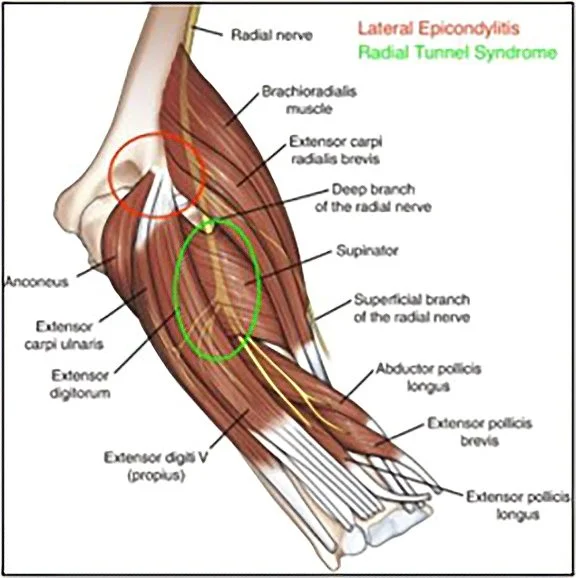
This is an overuse injury of the forearm and wrist extensor muscles, causing localized pain on the outside (lateral) of the forearm and elbow. It can often occur alongside Radial Tunnel Syndrome (RTS) due to shared mechanics and overlapping symptoms.
Radial tunnel syndrome (RTS)
This condition involves the entrapment or irritation of the radial nerve as it passes through the radial tunnel near the elbow. This primarily causes pain along the radial tunnel and into the extensor muscles.
In more advanced instances, this nerve compression can affect a motor nerve branch, leading to Posterior Interosseous Nerve Syndrome (PINS). PINS specifically impacts grip strength and control, making fine motor control (like point control) much more difficult.
Musculotendious strains
Strains of the large forearm and arm muscles, including the brachioradialis, triceps, biceps and forearm flexors and extensors, often occur through the cumulative stress of repetitive use. While these are certainly uncomfortable, they rarely become serious if they are managed early with rest and other intervention strategies including physical therapy, strength/conditioning exercises (S&C) and soft tissue care.
Fencing-Specific Causes and Biomechanics
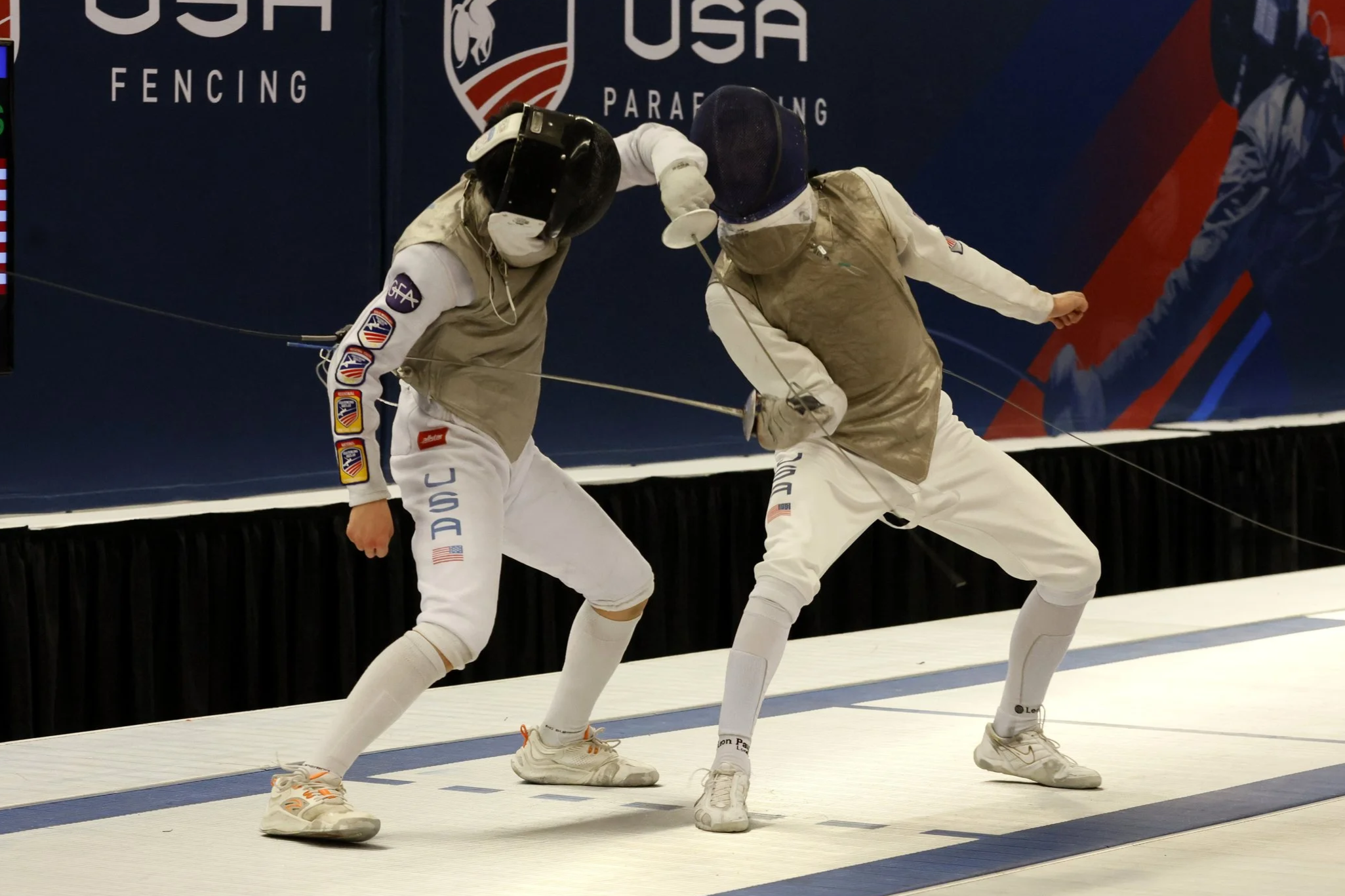
The unique mechanics of fencing place the upper extremity under continuous, often asymmetrical stress. Photo: Serge Timacheff/USA Fencing
The unique mechanics of fencing place the upper extremity under continuous, often asymmetrical stress.
Excessive grip tension
Many fencers, particularly beginners or those under stress, grip the weapon too tightly. This constant muscle contraction restricts blood flow and fatigues the forearm muscles, transferring load directly to the tendons at the elbow.
Repetitive Bladework
In foil and epee, the intricate, high-speed movements required for point control demand rapid, repeated contractions of the forearm muscles. This high frequency of movement can lead to microtrauma in the tendons over time.
Compensating for muscle imbalances
If a fencer’s core or leg drive is weak, they often try to make up the distance or power by over-extending the arm or over-controlling the wrist/fingers. These actions place undue strain on the forearm tendons. Similarly, a weak shoulder complex (such as the rotator cuff muscles) can force the smaller forearm muscles to overwork.
Improper grip type or fit
Using a grip that is too small or too large, or one that forces the wrist into an unnatural position, is a direct and chronic cause of tendon irritation and eventual pain.
Prevention and Management Strategies
Prevention for fencers should focus on reducing strain while building endurance and control.
Technique and equipment checks
Work with your coach, armorer or any other technical fencing specialist to ensure all equipment is correctly fitted to your specifications.
Targeted strength and endurance exercises:
Athletes should incorporate a comprehensive strength and conditioning program targeting the core, entire upper and lower body. For those managing elbow and forearm pain, prioritizing the following can help decrease long-term injury risk:
Shoulder Stability: A strong shoulder complex stabilizes the arm and reduces the need for the elbow to overcompensate. 5 Exercises to Improve Shoulder Stability
Thoracic Mobility: Good upper back mobility allows for proper reach and posture, taking stress off the arm. The Ultimate Thoracic Mobility Routine (Get Rid of Stiffness Fast!)
Elbow Strengthening: Targeted exercises build endurance in the muscles that handle the repetitive stress of the weapon. 4 Elbow Stability Exercises
Examples of specific elbow/forearm exercises:
Towel Twist: Wringing out a wet towel is a great way to build forearm endurance.
Wrist Extension/Flexion: Use light weights or a resistance band.
Grip Strengthening: Use a hand gripper or stress ball.
Forearm Supination and Pronation: With a light weight (1-2 lbs), rotate the forearm slowly (fist up/fist down movement).
Finger Extensions: Use a rubber band around the fingers to strengthen the extensors.
Active recovery & mobility
Incorporate these recovery activities before, during and after training:
Forearm Stretches: Target both the wrist flexor (inside) and extensor (outside) muscles.
Nerve Glides: Perform radial nerve glides to keep the nerve path mobile, especially if irritation is suspected. 4 Exercises for Radial Nerve Pain
Cold Therapy: Apply ice immediately post-competition or after an acute session if pain is present, or to reduce localized inflammation.
These guidelines are provided to increase awareness and do not replace medical experience or knowledge. Comprehensive programming or managing an existing injury should always be under the care of a qualified healthcare professional. If you have a chronic or acute injury that is not resolving, contact a sports medicine professional for an accurate diagnosis and a personalized treatment plan.
References
Chung, W.M., Yeung, S, Wong A.Y., Lam I.F., Tse P.T., Daswani D., & Lee, R. (2012). Musculoskeletal injuries in elite able-bodied and wheelchair foil fencers--a pilot study. Clinical Journal of Sports Medicine, 22(3), 278-80. https://doi.org/10.1097/JSM.0b013e31824a577e
Harmer, P.A. (2019). Epidemiology of time-loss injuries in international fencing: a prospective, 5-year analysis of Fédération Internationale d'Escrime competitions. British Journal of Sports Medicine, 53(7), 442-448. https://doi.org/10.1136/bjsports-2018-100002
Park, K.J., & Byung, S. (2016). Injuries in elite Korean fencers: an epidemiological study. British Journal of Sports Medicine, 51, 220-225. https://doi.org/10.1136/bjsports-2016-096754
Roi, G.S., & Bianchedi, D. (2008). The science of fencing: implications for performance and injury prevention. Sports Medicine, 38(6), 465-81. https://doi.org/10.2165/00007256-200838060-00003