
The Myth That Changed My Life
Editor’s Note: We are pleased to have Lauryn DeLuca, a 2016 US Paralympian, as a contributor and welcome her to American Fencer. In addition to serving on the USA Fencing Board of Directors, she is involved in World Para Fencing, working to increase the visibility of the sport.
My journey as a fencer, and likely my life, would look very different if Maestro Leslaw Stawicki had not approached my parents at a tournament in Columbus, Ohio.
“Your daughter… she’s disabled, yes?” Stawicki asked.
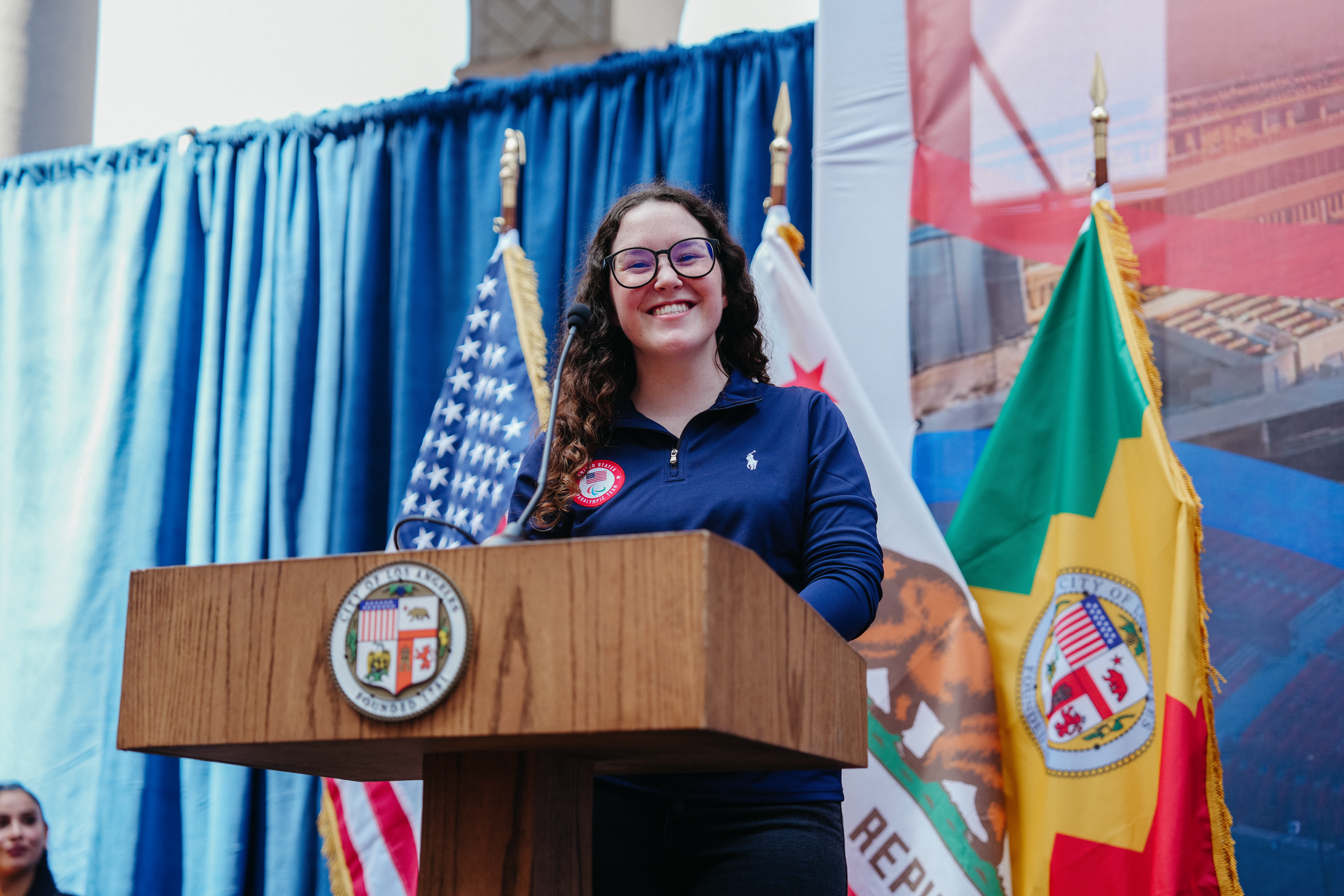
Lauren DeLuca, U.S. Paralympian
My parents were perplexed! Who is this Polish man asking about their daughter’s medical record? Unknown to my parents, Maestro Stawicki is considered the father of para fencing in the United States. He coached legends such as 1970 World Champion Victor Sidiak; Serge Prichodko; and silver medalists Ludomir Chronowski and Janusz Olech, and multiple Paralympic teams.
“I want your daughter to come to a wheelchair fencing camp.”
This was in 2013, when the visibility and representation of disabled sport was very limited. A time when Team USA was distinctly US Olympics and US Paralympics. A time when it was the United States Olympic Committee, not the United States Olympic and Paralympic Committee. A time when adaptive sport was mostly tied to the Special Olympics.
“But she doesn’t use a wheelchair full time,” my parents retorted.
I was born with cerebral palsy, a condition causing stiff and weak muscles, poor coordination and involuntary movements. Due to my parents’ advocacy and early intervention, I only need a leg brace as a mobility device to walk. When I started fencing at age nine, I fenced able-bodied without using my brace because fencing shoes didn't accommodate it; it simply did not feel great to lunge in a plastic brace. Without my brace, I limp and drag my left leg more. A limp and drag that is amplified after a long day of use, like at a Y14 able-bodied tournament.
“Ah, but in wheelchair fencing, the name is misleading; you don’t need to be a full-time chair user to compete. You just need a listed physical disability,” Stawicki continued.
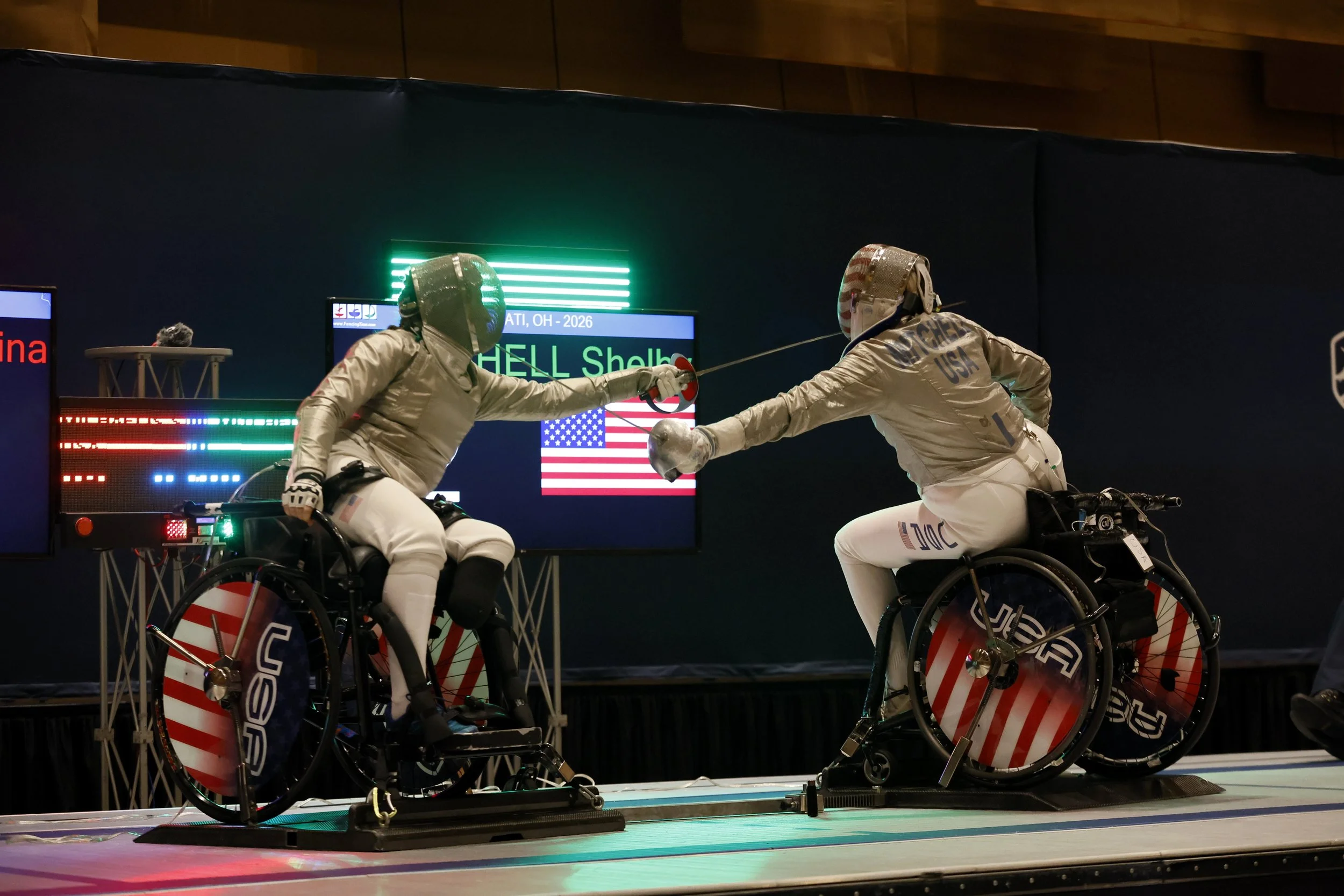
A lot of disabled people … don’t know that they could qualify for the Paralympics in an adaptive sport. Photo: Serge Timaccheff
And in that moment, a myth was busted. As a result, I attended my first wheelchair fencing team camp in Louisville, Kentucky. At that camp, I met disabled veterans (whom I lovingly say taught me to swear), met my eventual Paralympics teammate/big bro, the late Joey Brinson, Cat Bouwkamp and Ellen Geddes. Ellen and Cat were the first successful physically disabled women I met. At age 14, this did wonders for my self-esteem and outlook. Again, disabled representation was simply not a thing in the mid-2010s. I finally saw older versions of myself that allowed me to safely know that everything was going to be alright.
I often think about how a myth had me thinking that because I can walk/am semi- ambulatory, it meant I could not do adaptive sport. I am so thankful it was busted because my life would be completely different if I had given up fencing at age 13 just for physically not keeping-up with my competitors (Y14 is brutal!).
My story is not unique. A lot of disabled people, especially people like me who “pass” as able- bodied, don’t know that they could qualify for the Paralympics in an adaptive sport. Over the past few years, a lot of disabled sports organizations have rebranded from using “wheelchair” to using “para” (a change officially implemented by World Ability Sport in 2025 to rebrand to Para fencing) to capture the spectrum of physical disabilities that make up the sport. Para fencing is home to athletes with limb differences, spinal cord injuries and so much more.
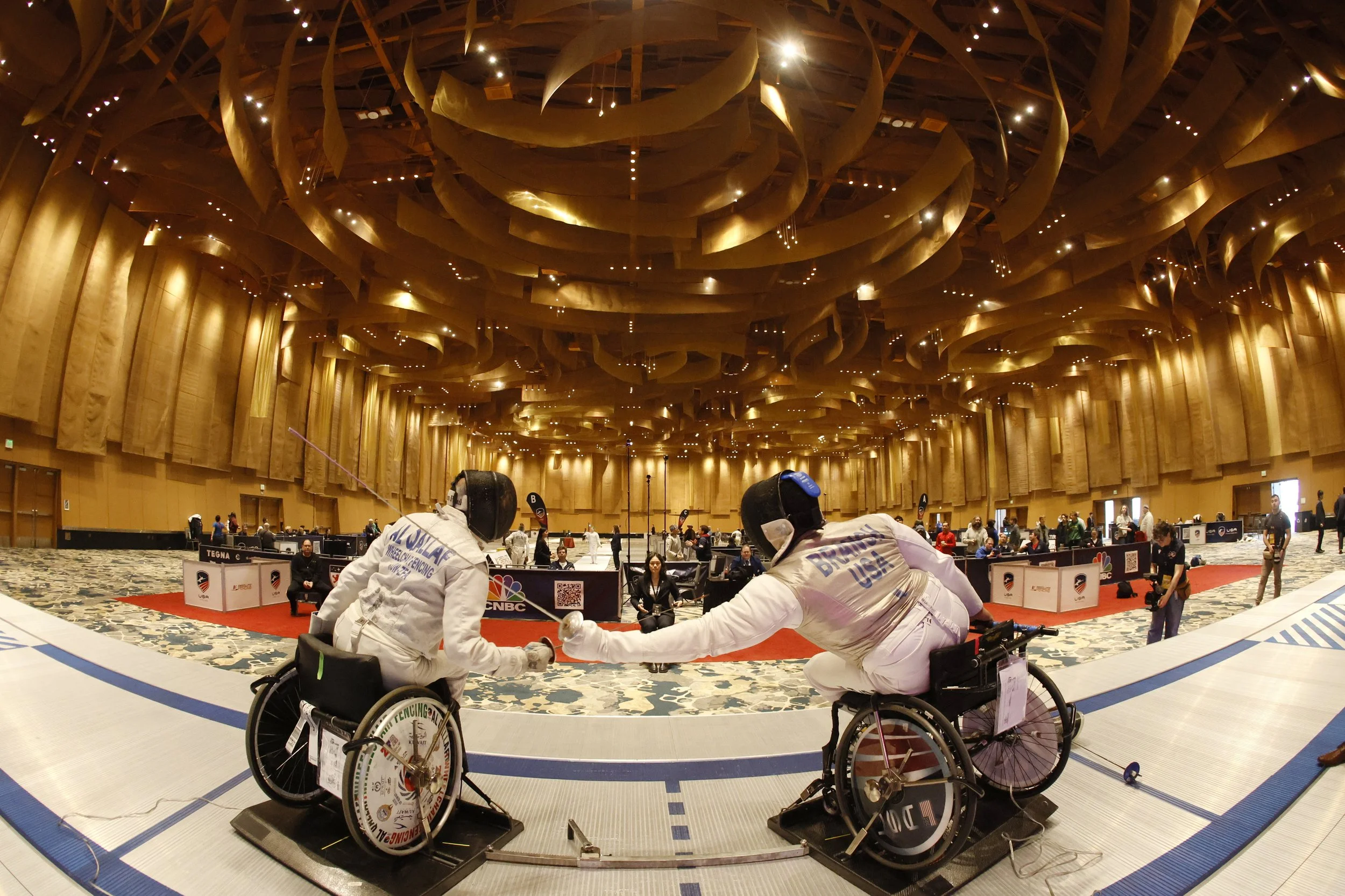
In Para fencing, every fencer needs to be classified into a category that allows them to compete amongst athletes of similar impairments to ensure fairness. Photo: Serge Timacheff
Now, please don’t go up to every person you know who walks with a limp and persuade them to join Para fencing purely with the intention of getting them to represent the Red, White and Blue at the Paralympic Games. There are several nuances at play, like classification.
In Para fencing, every fencer needs to be classified into a category that allows them to compete amongst athletes of similar impairments to ensure fairness. It would be wildly unfair if a Category C fencer, most commonly a quadriplegic, were to fence a Category A fencer, let’s say an amputee, who has full control of their core muscles, for a gold medal.
Recently, in 2025, the International Paralympic Committee implemented a new classification code and international standards. These established items such as eligible impairment assessment and a minimum impairment criteria assessment. With this change, international federations started implementing a system that caused the competition field to be shaken up. In Para fencing, we saw previous ‘A’ fencers like Paralympic gold medalist Amarilla Veres (HUN) no longer having an impairment severe enough, under the new classification guidelines, that deemed them eligible to compete internationally in para fencing. Since I can walk without my brace on “good days,” I’m willing to bet I would not be classified under the new system.
Revise your approach by asking your person if they would be interested in Para fencing as a sport for recreation and social community. Once they are ready to consider a step like a World Cup, the wickedly talented team at USA Fencing can guide them through all the steps necessary to get involved.
Most importantly, be the person who asks if fencing could change someone’s life.