
The Evolution of Weights and Measures
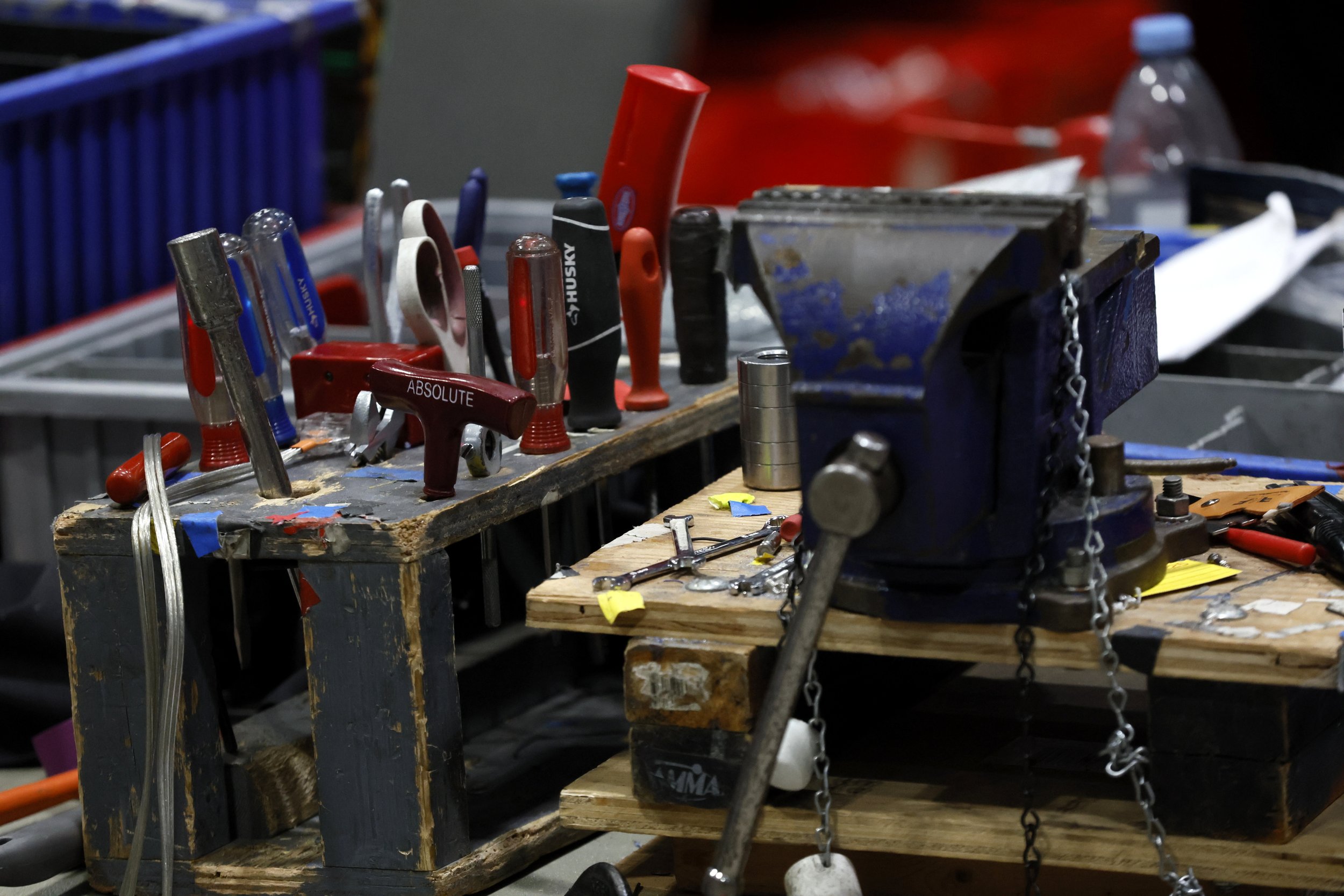
Maintaining and keeping fencing gear safe involves tools, measuring devices and the skills and knowledge needed to use them.
A quick quiz about some historical measurements no longer used: I have a set of shim gauges used during the 1980 Moscow Olympic Games that include two gauges, one with a gap measuring 2.4 cm and the other measuring 1.0 mm thick. Produced by Visti, they are accurately made of vanadium steel. For what purposes are these two gauges made?
The answers: The 2.4 cm gauge is to measure the maximum width of any side of an epee blade! Can you imagine fencing epee with a blade that’s almost an inch on each side of its forte? The 1.0 mm shim determines the maximum gap of a foil point – if the 1.0 mm shim fits into the gap between the barrel and the tip, it fails, as the foil tip is probably coming apart. In the case of the 1.0 mm foil shim, the old rules indicated that the travel of the tip, which would trigger a touch, could be “infinitesimal,” but no longer than 1.0 mm. As a matter of fact, some of the early foil points’ travel was so small that it could not be detected by feel.
There are other leftover measurements still in effect. For instance, why does the 500-gram probe used to test foil lamés have a hemispherical tip with a 4 mm radius? It’s because when electric foil was introduced in the 1950s, the 4mm radius was the dimension of the “beehive” and “pineapple” tips being used.
And what about the weights that the foil and epee pressure springs must reset? The epee pressure spring is designed to reset a 750-gram epee weight, supposedly simulating the force needed to pierce the human skin. And since the foil is supposed to be more of an academic weapon designed for more “elegant” fencing, the pressure needed to establish a touch was deemed to be less. Sidenote: A number of years ago, when there was a lot of discussion about how to eliminate the “flick,” thought to be ruining the “conversation of blades” in foil fencing, there was a discontinued experiment to increase the force necessary to establish a hit to 750 grams, the force of an epee hit.
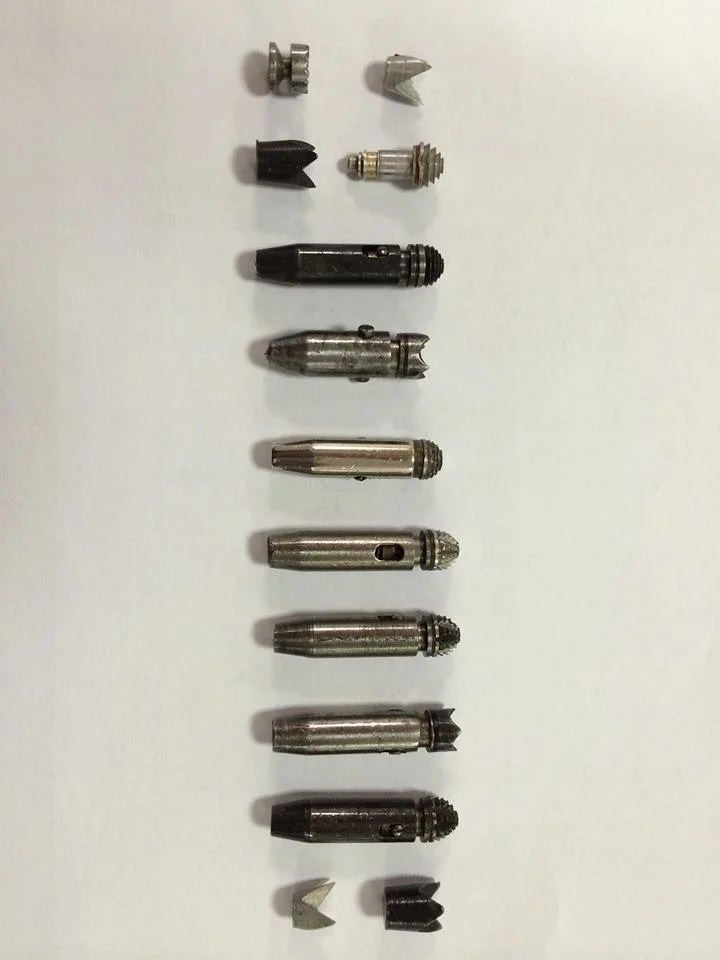
Over the years, there have been many types of weapon tips used, especially in epee.
And what about body cords? During the 1950’s, there was no regulation defining the length of the clip (“A”) wire of a foil – and later, sabre – body cord. That changed to the current minimum length of 40 cm because foil fencers, with very short “A” wires, in response to an attack, could cause the clip to disconnect from their lamés by twisting, thus causing a non-valid hit rather than a valid one. Interestingly, the dimensions for the ”A” line clip itself are those of a USA-produced Mueller #27 clip, introduced to the FIE by USA armorer Joseph Byrnes.
In some of the earliest two-prong foil body cords, both pins were the same diameter, rather than the 3 mm and 4 mm pins used on the modern cords. When hooking-up, the fencers had to determine which was the correct way the plug was inserted! If done correctly, valid hits could be scored; if not, only non-valid, off-target hits were registered – a problem still occurring today if a two-prong foil body cord is wired incorrectly.
In some instances, evolving technology has enabled changes in measurements while helping to maintain the conventions of the "conversations of blades." Such are the examples of the changes in double hit "lock-out" times in foil and saber, which happened in 2005 (for foil and sabre) and 2016 (for sabre) when the contemporary technology allowed for the relatively inexpensive upgrades in timing.
Other changes in scoring machines have been made because of changing technology including the inclusion of anti-blocage circuitry in scoring machines. Prior to the advent of digital technology, in foil, it was possible to nullify an opponent’s valid hit by placing your foil against your lamé. Using this technique, Soviet foil fencers were trained to place their blades against their lamés when riposting against fleché attacks. To prevent this grounding situation from occurring when a foil fencer had an uninsulated metal handle and a sweat-infused glove, foil handles, especially orthopedic ones, were required to be insulated. But, since the advent of digital circuitry, this problem has almost been eliminated.
Oh, yes! And there was the change in scoring from “hits received” to “hits for,” necessitating the changing of the lights indicating from “who was hit” to “who was hitting.”
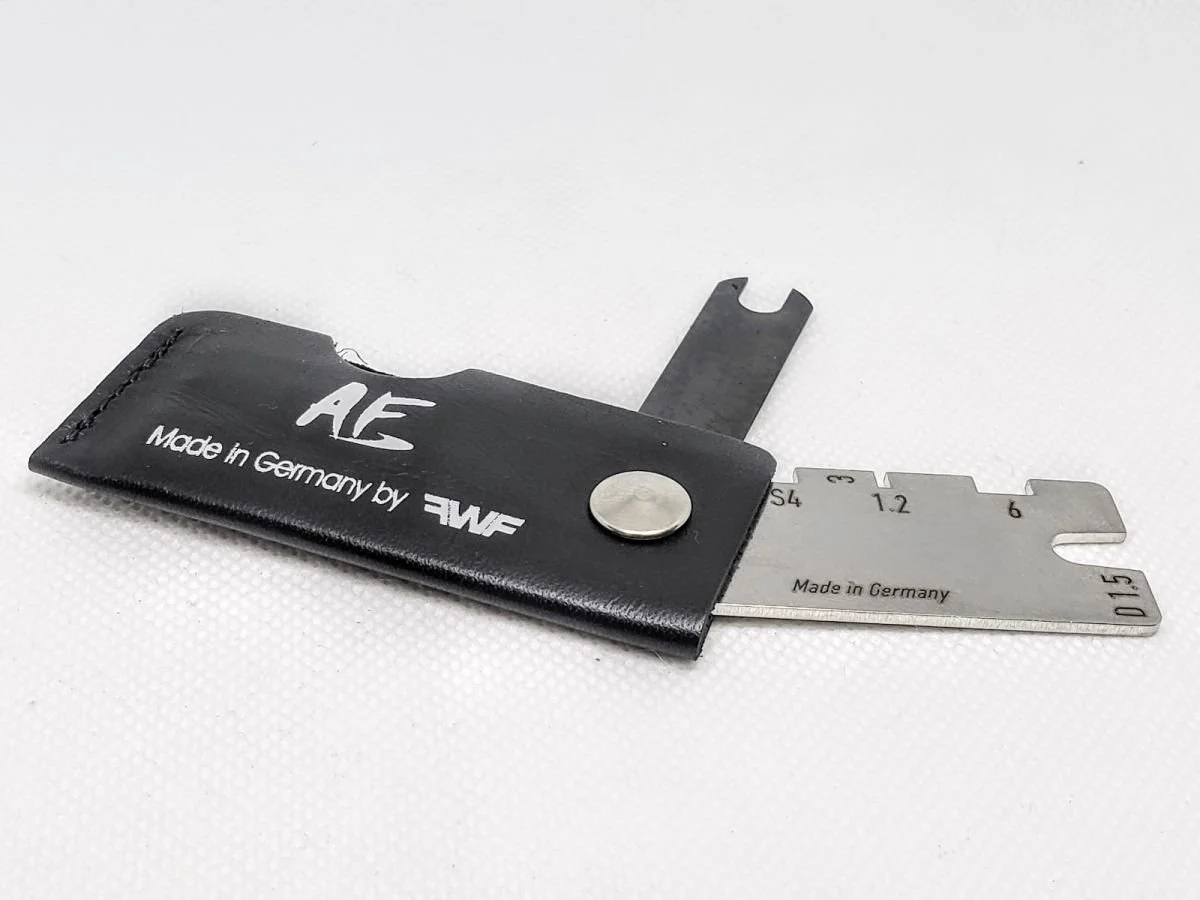
Every epee fencer needs to know how to use a shim to keep their weapons ready for competition.
There have been other changes made for fencers’ safety. Following the death of Vladimir Smirnov during the 1982 World Championships in Rome, the FIE put in place the standard for the strength of mask mesh: 12 kilograms. And with the 1986 World Championships, FIE homologated uniforms, with 800 newton puncture resistance, were required for all FIE events.
Accompanying its campaign to make fencing safer, the FIE also mandated the use of maraging steel blades in foil and epee to minimize the possibility of breakage during bouting. Sabre blades were initially exempted because cuts were thought to be less dangerous, but now maraging steel blades are required for FIE tournaments. Flexibility requirements for all blades to prevent people from altering their blades by filing and grinding them.
Driven by changes in the available technology and the changing nature of the sport, while trying to preserve the conventions of the three weapons, the specifications for fencing equipment have also changed, reflecting the continuing evolution of fencing in terms of safety and precision.