
If You Build It …
How to start, develop and maintain a parafencing program at your club.
Over the past few years, it has been amazing to see USA Fencing and its community embrace parafencing. By embracing this part of our identity, many community members have become champions for parafencing. When I hear another fencer say “Olympics AND Paralympics,” it makes me feel seen, and the invisible weight of advocacy lessens.
These champions of parafencing are the ones who volunteer at para NACs, donate to the USA Fencing Foundation, comment on posts, ask “What about para?” in committee meetings and so much more. The question I often hear, the one that seems to haunt the minds of these champions, is the following:
“But how can I start a para program at my club?”
When I started writing this article, the notoriously misquoted line from the 1989 film, Field of Dreams, came to mind: “If you build it, they will come.”
Ideally, the “recipe” for a para program comprises the following elements:
2 fencing wheelchairs or Jed’s Chairs
1 fencing frame
2 ratchet straps (to start)
1–2 coaches
Epee equipment (plus an epee skirt)
Foil equipment
Saber equipment
An accessible environment
3–4 para athletes
A club culture that is inclusive
A coach who is comfortable with being uncomfortable
A coach who is willing and able to adapt
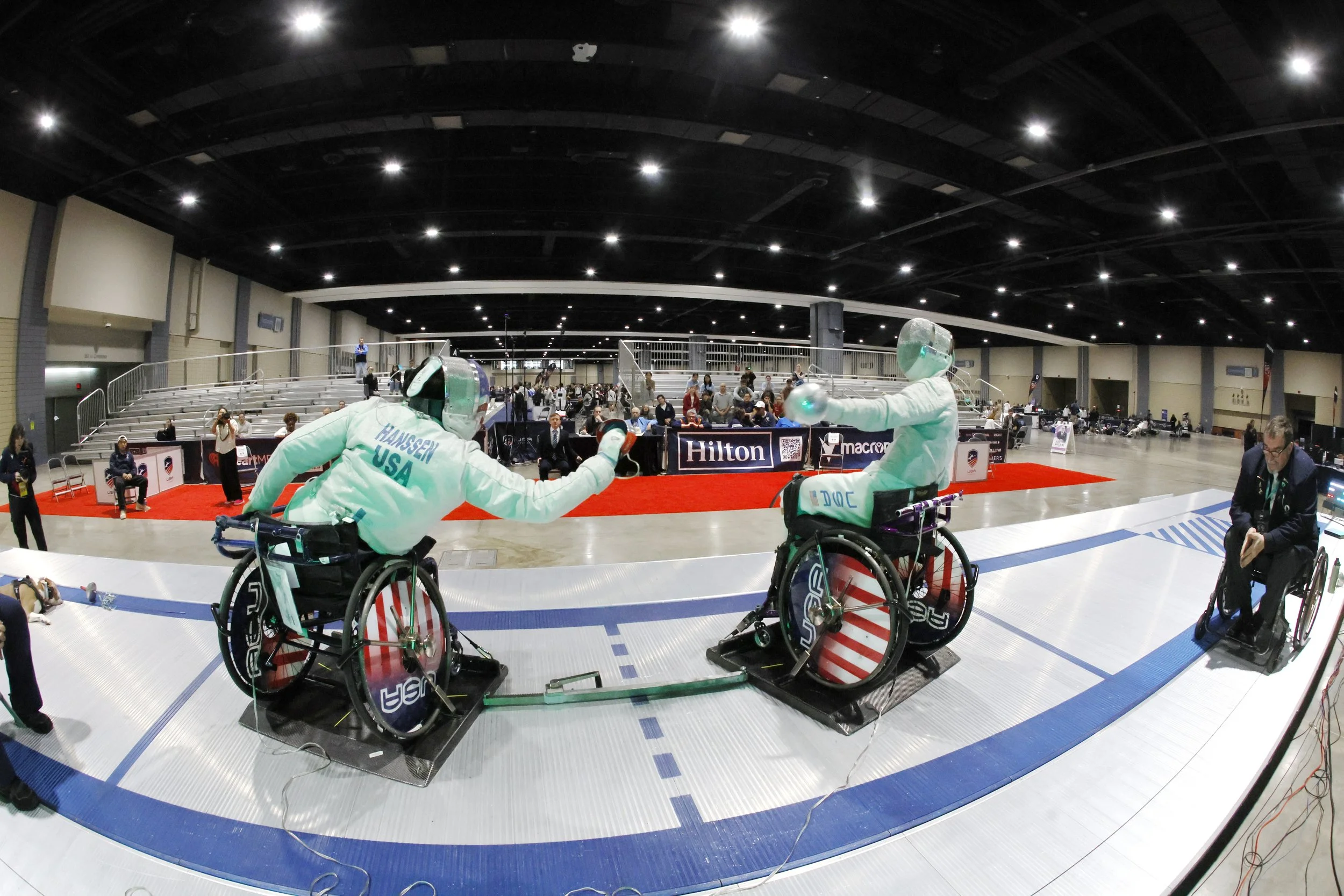
Parafencing and able-bodied fencing share many of the same fundamentals: equipment, technical terminology and tactical concepts.
I used to think that if we were all Kevin Costner, if we simply built para programs, athletes would come. Unfortunately, the “recipe” is only one piece of the puzzle. There are four additional pieces that are just as important.
Athletes
Interested clubs can work with local recreation organizations, disabled veterans groups and schools to connect with disabled athletes who may take an interest in the sport. On the youth side, parafencing has not yet reached the popularity or availability of other adaptive sports such as wheelchair basketball. Because of this, many clubs may benefit from attending showcase events specifically designed for the local disabled community.
Bonus: When you attend these events, you quickly realize people want to connect with everyone there because they instinctively understand “a rising tide lifts all boats.”
2. Funding
In the “recipe” above, I mention fencing frames and chairs. Unfortunately, these items are not especially budget-friendly. During my career, I used two fencing wheelchairs that cost approximately $5,000 each – chairs designed solely for fencing. The fencing frame itself costs around $4,000.
Thankfully, organizations like the Challenged Athletes Foundation and Utah Fencing Foundation can assist with securing fencing chairs. In addition, USA Fencing is getting ready to launch a frame lending program next season and periodically has grants available.
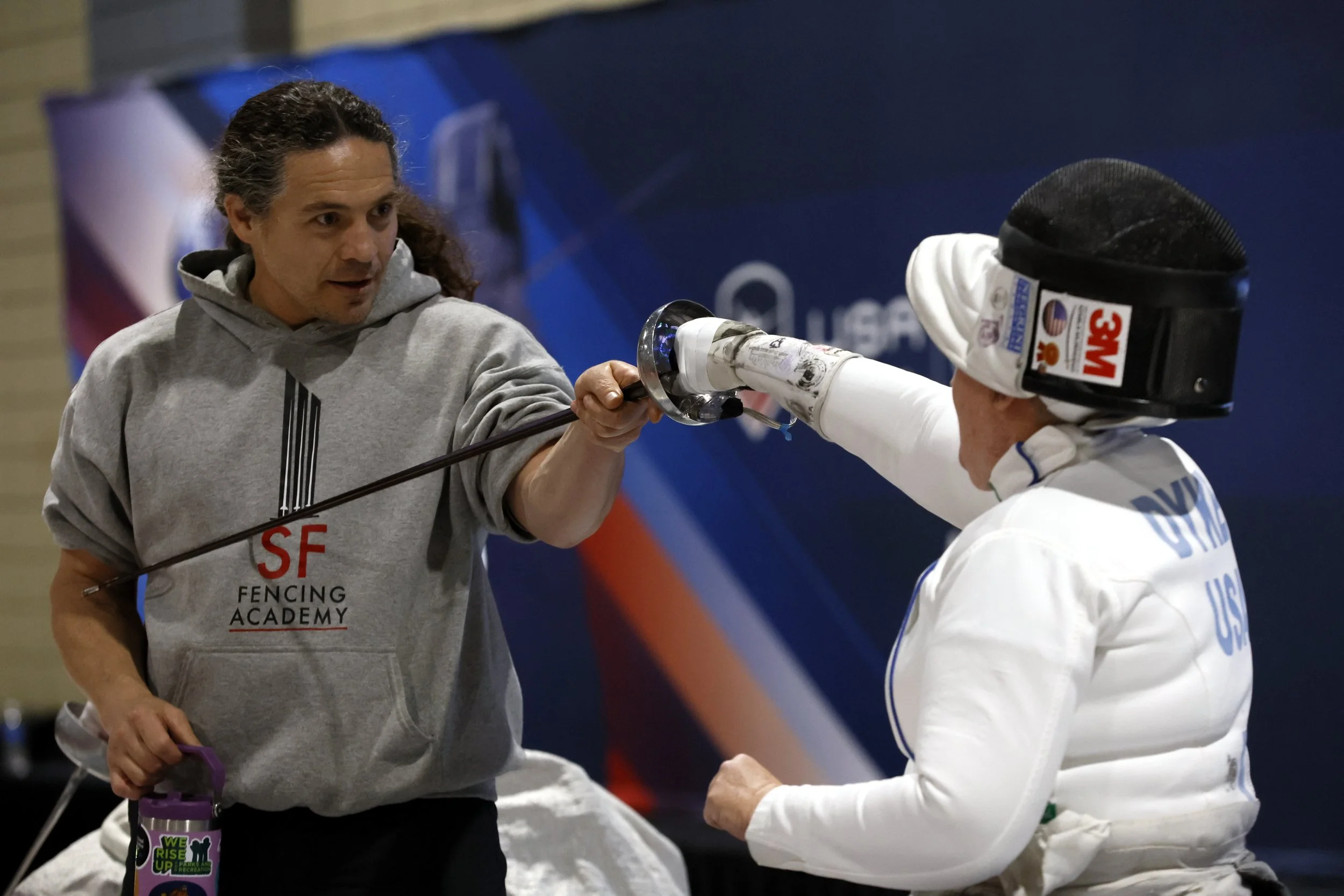
The U.S. Fencing Coaches Association is currently working on parafencing training.
3. Coaching
Able-bodied fencing has a history dating to medieval times, and because of that, coaching practices have traditionally centered on able-bodied athletes. I have found that many well-intentioned coaches are hesitant to coach parafencing because they are unsure how to adapt the sport or do not yet feel knowledgeable about how disabled bodies move and function within it.
Disclaimer: I am not a coach.
However, as the owner of a lopsided and disabled body, I have learned when a coach asks me: “What can you do? What can’t you do? What do you want out of this?” and says, “Are you okay with us figuring this out together?” I immediately feel at ease. It tells me that coach has my back and is willing to learn with and from me.
Again, I am not a coach, but I am a fan of fencing. Parafencing and able-bodied fencing share many of the same fundamentals: equipment, technical terminology and tactical concepts. There are slight nuances – such as distance and timing – setting the two apart. Thankfully, the U.S. Fencing Coaches Association is currently working on parafencing training, and our national coach, Eric Soyka, is known for being incredibly generous in mentoring and supporting developing para coaches.
4. Practice
In tandem with coaching is practice. Alas, I am once again haunted by another quote my Dad would quote to us in addition to, “If you build it, they will come,” which was. “How do you get to Carnegie Hall? Practice, practice, practice.”
For we fencers who may not be so musically inclined, we adapt this to “How do you get to a NAC? Practice, practice, practice.”
Fencers, able-bodied and para, go to their clubs to practice. Practice can be open bouting, group classes and even private lessons. Some clubs may offer “para only” lessons, and some may take “open” bouting to the next level by integrating para fencers in. There is no right way. The most important thing to be instilled into a fencing club’s practice pedagogy is everyone fences each fencer. It does not matter if that fencer is a beginner, world champion, left handed, blonde-haired or is disabled. They are a fencer and deserve to face other fencers.

Parafencing training at the U.S. Olympic & Paralympic Training Center in Colorado Springs, CO.
Bonus — another thing my dad said to us growing up was, “You can learn something from everyone. Even if it’s something you do not like doing at first.”
When fencers face others unlike them, such as someone being left handed, they learn how to adapt their game. When an able-bodied fencer sits down to fence a para fencer, they realize in real time they cannot depend on their legs to retreat. They adapt by using their hand more. The gain? Hand control skill that will carry into able-bodied fencing. An inclusive integrated training approach benefits all.
The real-life end credits of the “Piste” of Dreams
At the end of the day, building a parafencing program is not about having all the answers from the very beginning. It is about being willing to open the door, ask questions, adapt and learn alongside your athletes. And maybe that is where Field of Dreams got it right after all – not simply “if you build it, they will come,” but that building something with care and intention creates the possibility for people to belong. The strongest para programs are not built solely on equipment or funding; they are built on curiosity, community and a genuine belief that disabled athletes belong in our sport. Every coach who asks “What about para?”, every club that makes space for a wheelchair on the strip and every volunteer who chooses to show up help move our sport forward. While the work of advocacy can sometimes feel heavy, seeing more people embrace parafencing reminds me we are no longer carrying that weight alone.
Parafencing needs champions like you who are just one step away from having parafencing at their club. If you are interested in learning more and diving into more resources, please click here.
Photography: Serge Timacheff/USA Fencing