
Have Tournament, Will Travel: Know Before You Go!
Back in the “bad” old days – well before 9/11– when flying to a tournament, a fencer could actually take his or her loaded fencing bag into the cabin, to be stored in a compartment usually reserved for passengers’ coats. But today, that’s not possible. So, how do people fly their fencing equipment to tournaments?
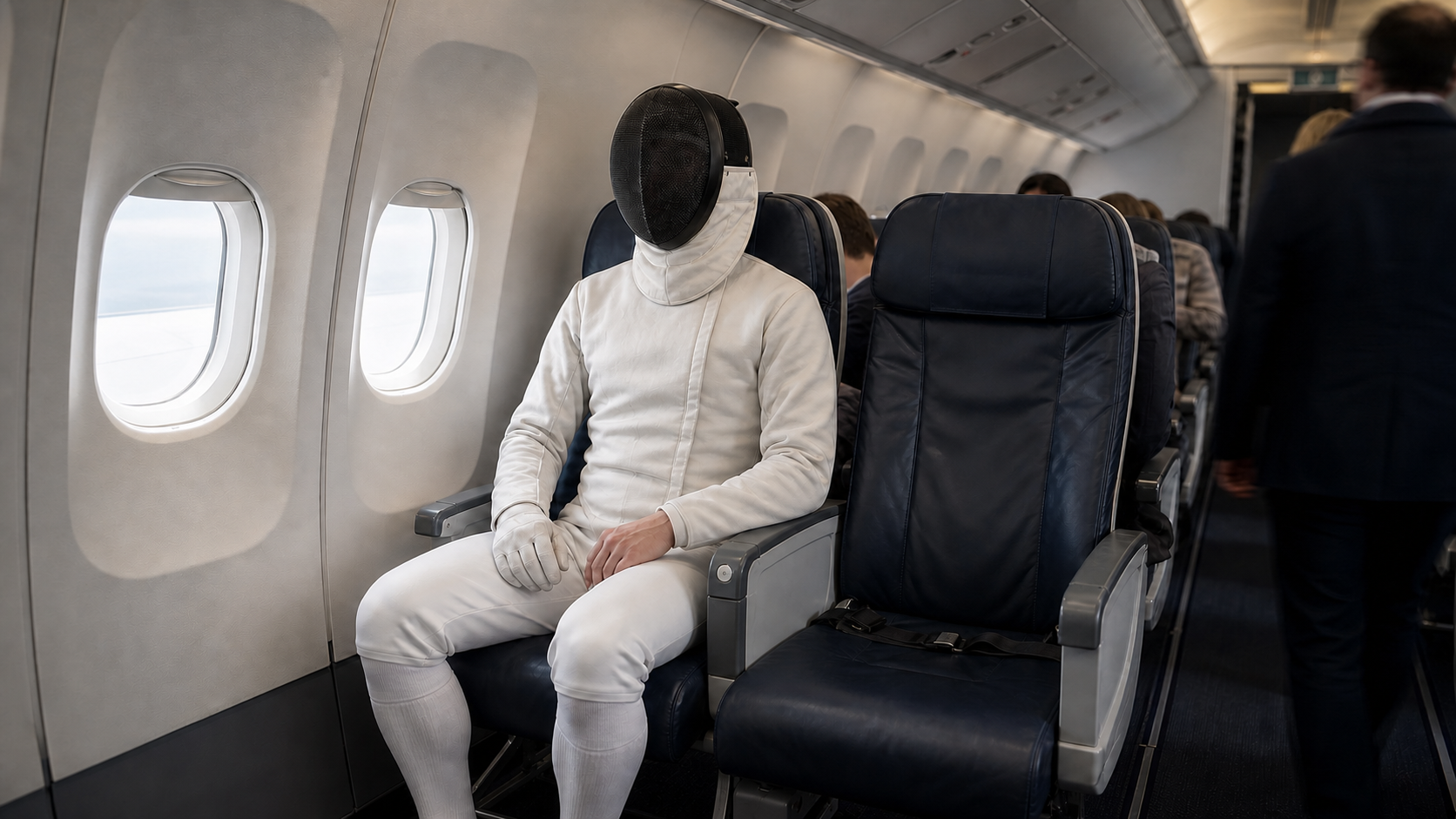
If you’re a competitive fencer, by now you’ve probably learned that travel is, at the very least, a necessary evil of our sport. As such, taking some basic and logical precautions will ensure your expensive gear lasts as long as possible while facing the rigors of participating in events in many locales.
The first consideration is to determine which fencing items are the most personal – what items are necessary to be most comfortable, meaning which ones do you really need to have that aren’t easily replaced? For most people, their mask and shoes are the most personal items. These should be carried on, rather than be packed.
In packing their equipment, some people use the hard-shell golf cases to pack their fencing equipment along with street clothes. One of the problems with doing so was illustrated by what happened a number of years ago at a tournament in Charlotte, NC, when a number of the hard-shell golf bags went missing at the airport. Apparently, someone at the airport thought that the cases contained saleable golf clubs and stole them. The broken cases were ultimately discovered in an airport dumpster along with their abandoned fencing equipment.
If you do use a hard-shell golf case for travel, it is a good idea to decorate the outside of the case with fencing stickers, alerting would-be thieves that the contents are not expensive golf clubs. And, of course, the case should be locked with TSA compliant locks, which makes it easier for TSA personnel to inspect the contents of the case – and so you don’t lose a lock they had to break.
If a soft-shell fencing bag is used, there is always the danger that its contents (especially guards and masks) will be deformed during baggage handling. A trick to avoid having smashed guards is to disassemble your weapons and place your stacked guards inside the mask you are going to be carrying on. Of course, this requires a number of requisites: you have to have the tools and skill to disassemble/reassemble your weapons; you have to have the time before competing to reassemble and test your weapons; and for foils and epees, their blade wires must be long enough to endure a number of cutbacks. For foil and epee blades themselves, it is best to tape the blade wires to the tang to prevent them from being broken in transit. Some people like to sheath their blades in PVC tubing, but the real purpose of that tubing is to keep damp/wet fencing uniforms from coming in contact with rusty carbon steel blades – or to expose the metal to moisture. I’ve seen weapon bags run over by a car: the only damage was to the guards and masks – the blades were perfectly fine.
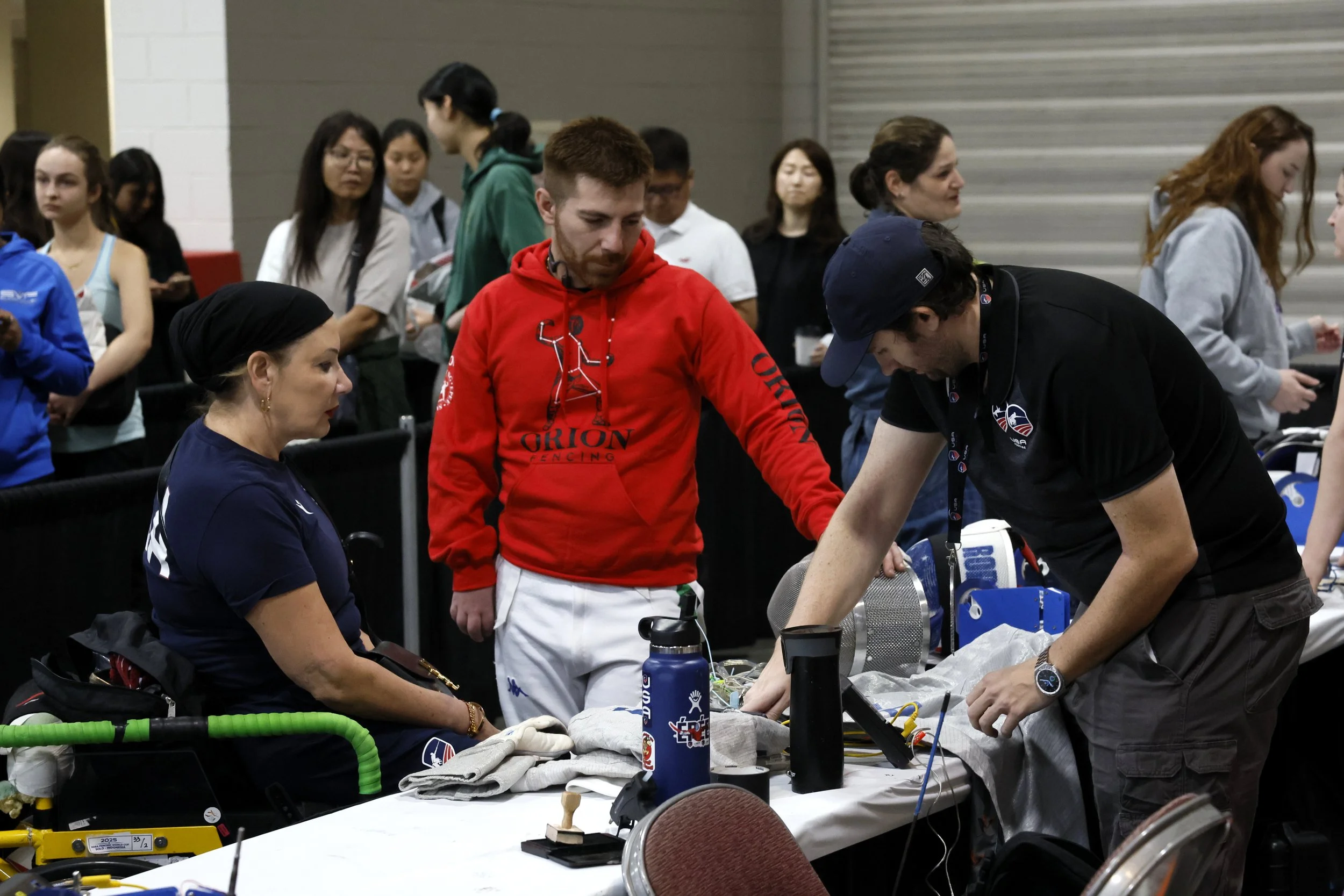
The usual number of items that can be put through controle is three or four body wires, three or four mask cords, two gloves, two masks and two lamés.
Body and mask cords should be bundled before packing. Some fencing bags have zippered compartments suited for transporting cords and small tools (e.g., pommel tightening tool, tip screwdriver, tip tape, cyanoacrylate glue, etc.). To save space, some people pack their fencing shoes with their cords, while others pack their cords in small breathable bags, not sandwich bags, as (again!) moisture is the enemy of fencing equipment.
To prevent damage to lamés, they should be rolled in something like a dry dish towel – bath towels are too thick – rather than being folded. Folding lamés, especially in the same pattern, increases the likelihood of them failing.
When it comes to the “whites,” there is generally no problem packing them going to a tournament, but where the concerns happen is at the end of the tournament when there might be a rush to get packed because of an impending flight home. All too often jackets, knickers, socks and plastrons are jammed into a fencing bag where they might become moldy.
Clearly, moisture, especially sweat, is the enemy of fencing equipment, and the drier you can keep your equipment, the longer it will last. When it comes to sweaty uniforms, steel and copper wires are all packed together into a waterproof container, the results are not pretty. There is a story about an abandoned bag of fencing gear (uniforms, masks, weapons, cords) spending a humid Texas summer in a garage. Can you imagine what a toxic biohazard it was when it was retrieved by its owner? While this is an extreme case, when exposed to moisture, the metal in weapons, lamés and cords tends to degrade/rust over time, foam padding in masks tends to disintegrate, and uniforms tend to stain and develop a permanent odor.

The cure is to isolate uniforms from the rest of the packed items for the homeward trip, and to wash and thoroughly dry everything once it arrives home. Carrying a dry cleaning bag is a good way to isolate wet clothing from the other packed items.
How many spares should be packed? As NACs have vendors, there is Phileas Fogg’s advice, about traveling light but carrying cash, or its modern equivalent, the credit/debit card. While the rules governing the minimum amount of equipment a fencer must have on the strip (two weapons, two body wires, two mask wires), the usual number of items that can be put through controle is three or four body wires, three or four mask cords, two gloves, two masks and two lamés. These numbers should be considered minimum. Having one or two spare blades, cut, canted and fitted to your handles can save a lot of angst if a blade breaks during competition. Of course, all the equipment being taken should be thoroughly checked for functionality. Some epee and foil fencers will change all of their pressure springs before packing them.
Finally, one of the goals in packing for airline travel is to keep the weight below the maximum 50 pound limit. Using a bathroom scale, or a cheap travel luggage scale can save having to pay for excess poundage. If you are approaching the 50-pound limit, try splitting the weight between your fencing bag and carry-on.